
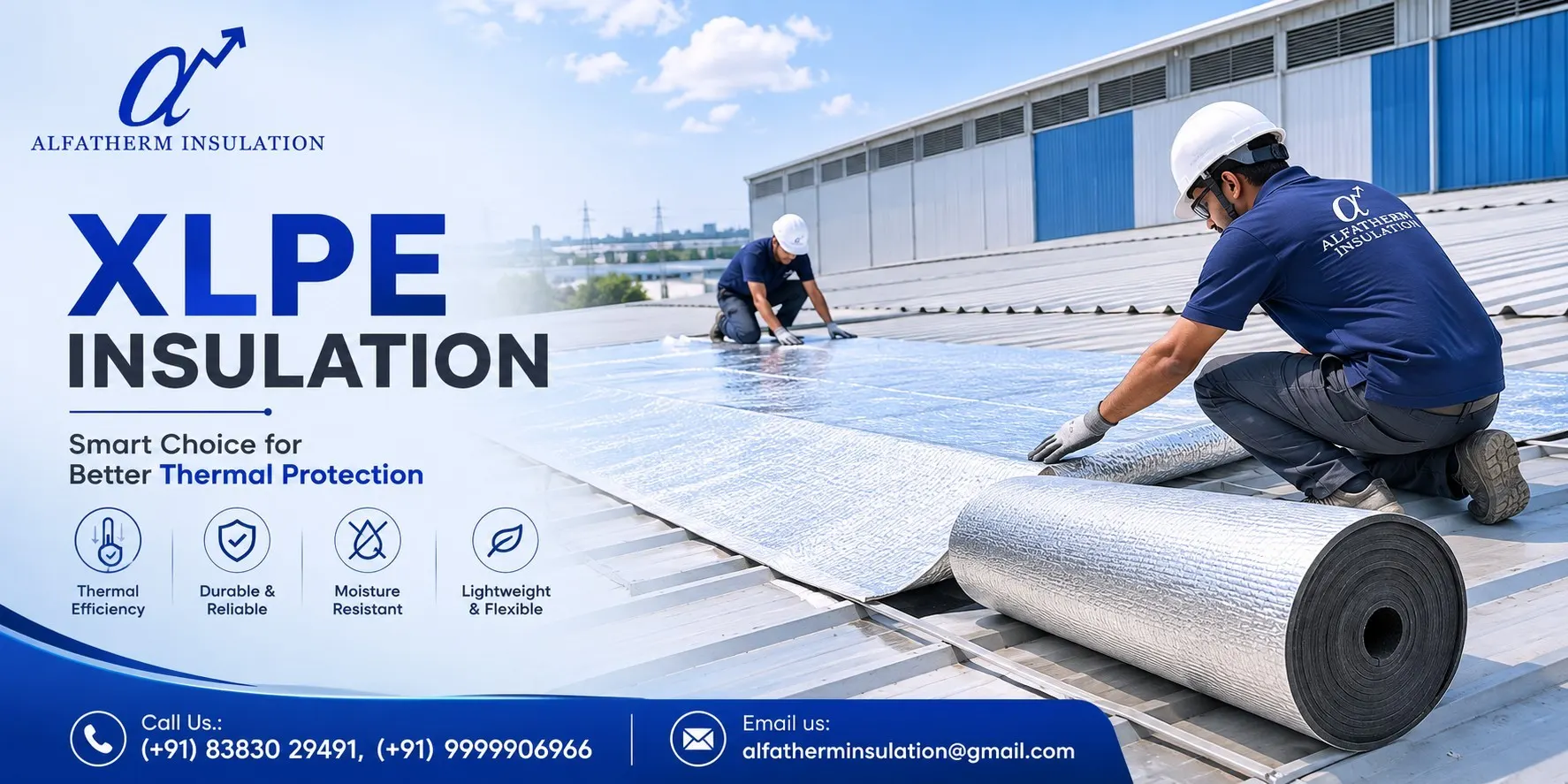
Features of XLPE Insulation: What Makes It a Smart Choice for Better Thermal Protection?
When you think about insulation, the first thing that probably comes to mind is simple — stop heat from moving where it shouldn’t.
But in real projects, it’s not quite that simple.
The insulation has to deal with moisture, temperature changes, physical handling, installation conditions and, of course, it needs to keep doing its job for years. A material that looks good on paper but starts losing its performance after a while isn’t really a good solution.
This is where XLPE insulation comes into the picture.
XLPE, or Cross Linked Polyethylene, is a closed-cell insulation material that is widely used for thermal insulation applications. Its combination of low heat transfer, moisture resistance, flexibility and mechanical stability makes it suitable for HVAC, refrigeration, piping and several other applications.
So, what exactly makes XLPE different?
Let’s take a closer look at the features of XLPE insulation, and more importantly, why those features actually matter when you’re selecting insulation for a project.
First, What Exactly Is XLPE Insulation?
XLPE stands for Cross Linked Polyethylene. In simple words, it is a polyethylene-based material that goes through a cross-linking process, creating a stronger and more stable structure.
For thermal insulation, XLPE is commonly made as a fine-cell, closed-cell foam. These tiny closed cells are a big part of what gives the material its insulating properties. They help slow down heat transfer while also making it harder for moisture to move through the insulation.
And that matters quite a lot in applications such as chilled-water pipes, air-conditioning systems and refrigeration, where unwanted heat gain and condensation can become real problems.
The interesting part is that XLPE isn’t only about thermal performance. Its physical properties also make it relatively easy to handle and install. So you get a material that is doing more than just acting as a thermal barrier.
The Features of XLPE Insulation That Actually Matter:
It Provides Reliable Thermal Insulation
Let’s start with the obvious one — thermal performance.
The whole point of insulation is to reduce unwanted heat movement, and XLPE is designed to do exactly that. Its closed-cell structure helps create a barrier between the surface being insulated and the surrounding environment.
For example, consider a chilled-water pipe running through a warm area. Without proper insulation, heat from the surroundings can gradually reach the pipe, affecting the temperature of the water and putting additional load on the cooling system.
Good XLPE insulation helps reduce that heat transfer.
The result is better temperature control and, depending on the system and installation, potentially better overall energy efficiency. That’s one of the main reasons thermal performance remains one of the most important features of XLPE insulation.
Its Closed-Cell Structure Helps With Moisture
Here’s something that is often overlooked when people compare insulation materials — moisture.
Insulation can perform well initially, but if moisture starts getting into the material, its thermal performance can be affected. This becomes particularly important in humid environments and around chilled-water or air-conditioning systems.
XLPE’s closed-cell construction helps restrict water and water-vapour movement through the material. This is one reason it is commonly considered for applications where condensation control is important.
Of course, the insulation itself isn’t a magic solution. Joints, seams and installation quality still matter. Even a good insulation material can underperform if it’s installed with gaps or poorly sealed connections.
That’s worth keeping in mind.
It Handles Temperature Changes Well
Insulation doesn’t always get to work in comfortable conditions.
Depending on where it is installed, it can experience changing temperatures throughout the day or across different operating conditions. A suitable XLPE product is designed to maintain its physical and thermal characteristics within its specified operating range.
This makes it useful for systems where temperature control is important.
The exact temperature range, though, depends on the particular product. So rather than assuming that every XLPE product has the same rating, it’s better to check the manufacturer’s technical specifications before making a selection.
That small step can save a lot of trouble later.
Lightweight — Which Makes Installation Easier
Ask any installer and they’ll tell you that the material itself isn’t the only consideration. How easy it is to carry, cut, fit and work with can make a big difference on site.
XLPE is relatively lightweight and workable, which makes it convenient for many insulation installations.
It can be cut and shaped according to the requirement and fitted around pipes, bends, joints and other surfaces. For larger HVAC or industrial projects, this can make the installation process a little quicker and less cumbersome.
And when you’re dealing with hundreds or thousands of metres of piping, those small conveniences start adding up.
Flexibility Without Losing Its Structure
Insulation has to fit the system — not the other way around.
Pipes have bends. Connections have different shapes. Equipment has corners and awkward areas. A rigid material can make these areas difficult to insulate properly.
XLPE offers a useful balance of flexibility and mechanical strength. It can accommodate practical installation requirements while still maintaining its basic structure.
This is particularly useful when the insulation needs to follow curved or irregular surfaces.
The result is a cleaner fit and, ideally, more continuous insulation coverage.
It Offers Good Dimensional Stability
This is another feature that doesn’t always get enough attention.
Imagine installing insulation properly and then, over time, the material changes shape enough to create gaps. Those gaps can become weak points in the insulation system.
The cross-linked structure of XLPE helps the material maintain dimensional stability under suitable conditions. Some XLPE insulation products are also designed to recover their original shape after compression, often referred to as a “memory effect.”
Why does that matter?
Because consistent coverage matters. The fewer unwanted gaps and exposed areas you have, the easier it is to maintain the intended thermal performance of the system.
Durable Enough for Long-Term Use
No one wants to keep replacing insulation.
Once insulation is installed, the expectation is pretty straightforward — it should stay in place and continue doing its job.
XLPE is designed to provide durability along with thermal and moisture-resistance characteristics. Depending on the product and its environment, it can withstand normal mechanical handling and various environmental conditions.
Some XLPE products are also designed to resist weathering and chemicals, although the actual resistance will vary by product specification.
So, when choosing XLPE insulation material, it is always better to look beyond the basic price per metre or sheet. The expected operating environment matters just as much.
Where Can XLPE Insulation Be Used?
One reason XLPE has become a useful option is that it isn’t limited to one particular type of project.
You can find XLPE-based thermal insulation solutions in HVAC systems, chilled-water pipelines, refrigeration, plumbing, ductwork and building services. It can also be considered for commercial, residential and industrial applications where thermal protection and moisture control are required.
For HVAC systems, for instance, the focus is often on controlling heat transfer and condensation.
For refrigeration, maintaining the desired temperature becomes even more important.
And in plumbing or hot and cold-water applications, insulation can help manage heat loss or gain depending on the system.
The right thickness and product specification will naturally vary from one application to another. That’s why the application should come first, rather than simply choosing a material because it is popular.
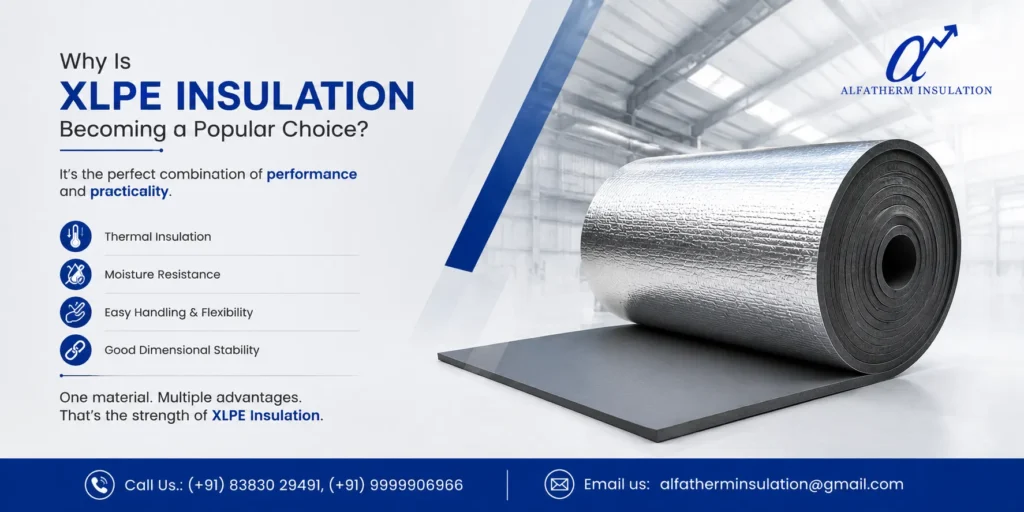
Why Is XLPE Insulation Becoming a Popular Choice?
There isn’t one single reason.
It’s really the combination of several things.
You get thermal insulation, moisture resistance, relatively easy handling, flexibility and good dimensional stability in one material. That combination makes XLPE insulation attractive for projects where performance and practical installation both matter.
And honestly, that’s what a good insulation material should do.
It shouldn’t create another problem while solving one.
Of course, XLPE isn’t automatically the right answer for every application. Operating temperature, required insulation thickness, environmental exposure, installation method and other project conditions should all be checked before selecting the material.
Choosing the Right XLPE Insulation for Your Project
This is where working with an experienced insulation supplier can make the process much easier.
Instead of simply asking, “Which insulation is cheapest?”, it’s better to ask a few more useful questions.
What temperature will the system operate at?
Is condensation a concern?
Will the insulation be exposed to moisture?
How much mechanical handling will it face?
What thickness is actually required?
And, perhaps most importantly, where is the insulation going to be installed?
These details help determine whether a particular XLPE insulation product is suitable for the job.
At Alfatherm Insulation, the focus is on helping customers find insulation solutions according to their actual application requirements. Whether the project involves HVAC, refrigeration, piping or other thermal insulation needs, selecting the right material and specification is an important part of getting the expected performance.
A Better Understanding Leads to a Better Insulation Choice
Insulation may not be the most visible part of a building or industrial system, but it quietly does a very important job.
It helps control temperature. It helps manage condensation. It protects the performance of the system and, when properly selected and installed, can continue doing that for a long time.
That’s what makes understanding the features of XLPE insulation worthwhile.
Its closed-cell structure, thermal insulation capability, moisture resistance, flexibility, lightweight construction and dimensional stability make it a practical option for many modern insulation requirements.
But the best insulation isn’t simply the material with the longest list of features. It’s the one that actually fits the conditions of your project.
If you’re looking for XLPE insulation in Delhi or want to understand which XLPE solution would work for your application, Alfatherm Insulation can help you evaluate the requirement and choose accordingly.
Because good insulation isn’t just about covering a surface. It’s about protecting the performance of the system underneath it.
0 comments