
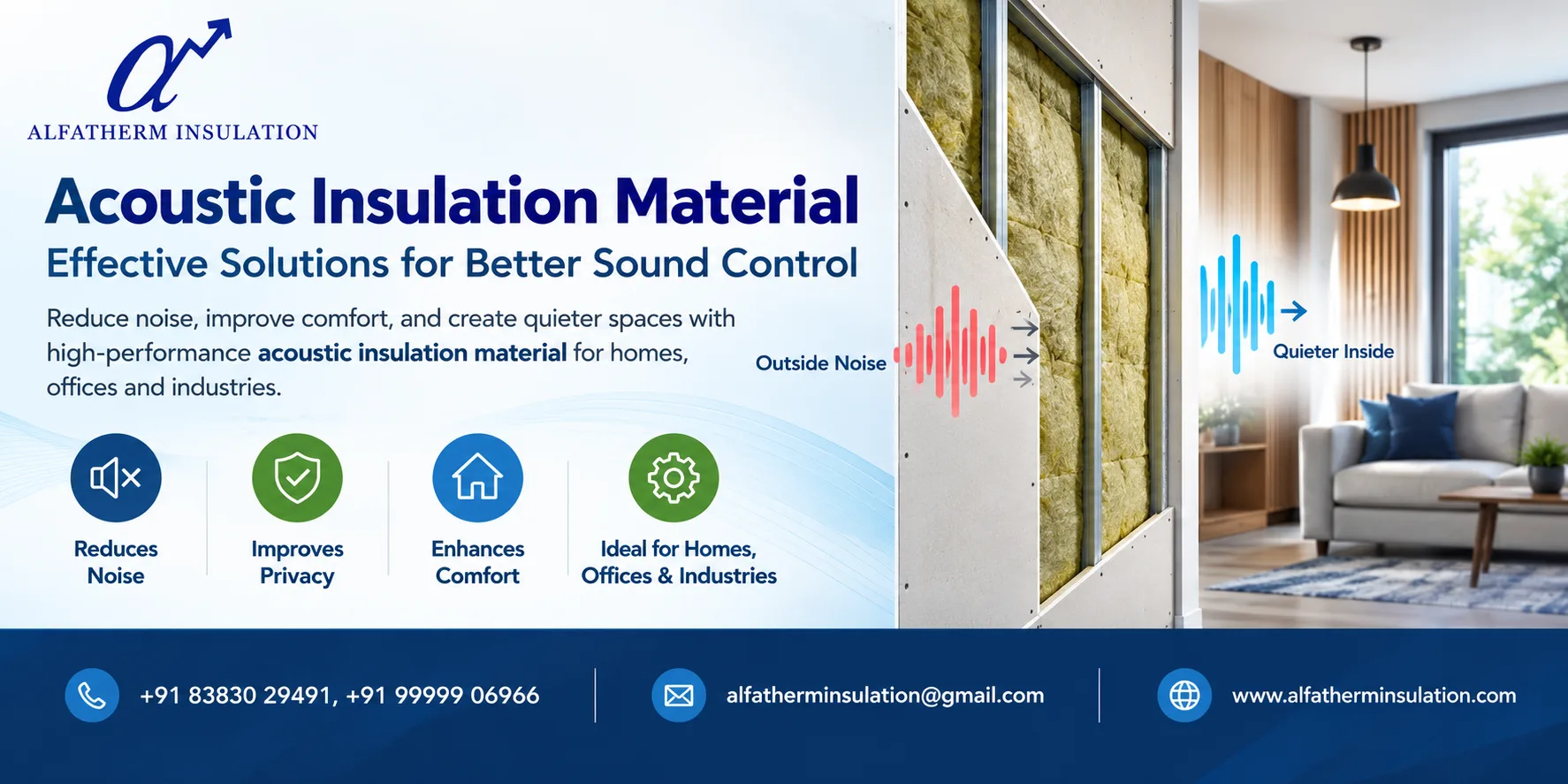
Acoustic Insulation Material: Effective Solutions for Better Sound Control
Introduction
Noise is a common concern in homes, offices, commercial buildings, studios, hospitals, educational institutions, and industrial facilities. Traffic, machinery, conversations, HVAC equipment, and other sources can affect comfort, privacy, communication, and productivity. Choosing the right Acoustic Insulation Material can help control unwanted sound and create a more comfortable indoor environment.
Effective acoustic design is not only about selecting an insulation product. The construction of walls, ceilings, floors, partitions, doors, windows, and other building components also influences overall acoustic performance. Alfatherm Insulation can help customers identify suitable insulation solutions according to their project requirements and application conditions.
What Is Acoustic Insulation Material?
Acoustic Insulation Material refers to materials or systems used to manage unwanted sound within or between spaces. Depending on the product and installation method, these materials can absorb sound energy, reduce sound transmission, or support both objectives.
Common solutions include mineral wool, glass wool, acoustic panels, acoustic barriers, and other specialized insulation products. Fibrous materials can absorb sound by allowing sound waves to enter their porous structure, where part of the acoustic energy is dissipated.
The correct product depends on factors such as the noise source, frequency range, wall or ceiling construction, available installation space, fire requirements, moisture conditions, and required acoustic performance.
Why Acoustic Insulation Is Important
Buildings contain several potential sources of unwanted noise. In residential spaces, noise may come from traffic, neighboring rooms, appliances, or entertainment systems. Offices may experience conversations, equipment noise, and HVAC sounds. Industrial environments can have machinery, compressors, pumps, fans, and production equipment.
Using suitable Acoustic Insulation Material can contribute to a quieter and more comfortable environment.
Important benefits include:
- Reduced unwanted sound transmission
- Better speech clarity
- Improved privacy between rooms
- Reduced echo and reverberation
- Better acoustic comfort
- Improved working environments
- Support for quieter mechanical systems
- Better conditions for studios and media rooms
However, the material should always be selected according to the specific acoustic problem. A product designed primarily for sound absorption may not provide the same performance as a complete sound-isolation system.
Sound Absorption and Sound Insulation
Understanding the difference between absorption and insulation is essential when planning an acoustic solution.
Sound Absorption
Sound absorption reduces reflected sound within a room. Porous materials can absorb a portion of sound energy, helping control reverberation and improve speech intelligibility.
Absorption is particularly useful in:
- Conference rooms
- Classrooms
- Offices
- Auditoriums
- Recording studios
- Restaurants
- Home theaters
The Noise Reduction Coefficient, or NRC, is one commonly used measurement associated with sound absorption.
Sound Insulation
Sound insulation focuses on reducing the transmission of sound from one space to another. The Sound Transmission Class, or STC, is commonly used to describe airborne sound transmission through a building assembly.
It is important to understand that STC generally relates to the complete assembly rather than the insulation product alone. Wall layers, framing, boards, air gaps, resilient connections, doors, windows, and sealing can all influence the final result.
Types of Acoustic Insulation Materials
Different applications require different acoustic approaches. Some commonly used options include:
- Mineral Wool
Mineral wool has a fibrous structure that can provide sound absorption and contribute to the acoustic performance of wall, ceiling, floor, and partition assemblies. It is also used where thermal and fire-performance requirements are important. - Glass Wool
Glass wool is a lightweight fibrous insulation material used for thermal and acoustic applications. It can be installed within cavities to help absorb sound and improve the performance of suitable building systems. - Acoustic Panels
Acoustic panels are primarily used to control reflections and reverberation inside rooms. They are commonly found in offices, meeting rooms, classrooms, studios, and other spaces where speech clarity is important. - Acoustic Barriers
Dense barriers add mass to a construction system and can help reduce airborne sound transmission. They are often combined with cavity insulation and other layers to create a more complete acoustic assembly. - Resilient Systems
Resilient channels, clips, and related components can reduce rigid connections between building layers. Decoupling can be useful when designing systems for improved sound isolation.
Applications of Acoustic Insulation
- Residential Buildings
Homes can use acoustic insulation in partition walls, ceilings, floors, bedrooms, living areas, and home theaters. Properly designed systems can help reduce noise transfer between rooms and improve privacy. - Offices
Offices require good acoustic conditions for meetings, focused work, telephone calls, and collaboration. Insulation combined with appropriate partitions and interior acoustic treatment can help control unwanted sound. - Recording Studios
Studios generally require both sound isolation and internal sound absorption. Insulation can form part of wall and ceiling assemblies, while dedicated acoustic treatments help manage reflections within the recording environment. - Industrial Facilities
Factories may contain machinery, compressors, pumps, fans, and other equipment that generate continuous noise. Acoustic solutions can be incorporated into equipment enclosures, partitions, walls, ceilings, and mechanical systems. - Commercial Buildings
Hotels, hospitals, schools, restaurants, auditoriums, and retail spaces can have different acoustic requirements. The design should consider the building’s use, expected noise sources, and required level of acoustic control.
How to Choose the Right Acoustic Insulation Material
Selecting the correct Acoustic Insulation Material should begin with understanding the actual noise problem.
- Identify the Noise Source
Determine whether the noise originates from machinery, people, traffic, music, HVAC equipment, footsteps, or another source. The frequency and intensity of the sound can influence the appropriate solution. - Determine the Acoustic Objective
If the primary issue is echo within a room, sound absorption may be required. If sound is passing through a wall or ceiling, sound isolation should receive greater attention. - Review Technical Data
Manufacturer documentation should be checked for acoustic test results, installation requirements, fire performance, thermal properties, density, thickness, and applicable standards. - Consider the Available Space
The depth of a wall cavity, ceiling void, or floor system can affect which insulation product can be installed effectively. The material should fit the designed assembly without creating installation problems. - Consider Fire and Moisture Requirements
The selected system should be suitable for the building environment. Fire resistance, moisture exposure, operating temperature, and durability may all need consideration depending on the application.
Why Installation Quality Matters
Even a high-quality Acoustic Insulation Material may not deliver the expected result if installation is poor. Gaps, unsealed penetrations, rigid connections, poorly fitted doors, and other weak points can create pathways for sound transmission.
For this reason, installation should follow the manufacturer’s recommendations and the specifications of the designed acoustic assembly. Attention to joints, edges, penetrations, and connections is particularly important.
A complete acoustic approach should consider the entire building system rather than focusing on insulation alone.

Alfatherm Insulation for Acoustic Applications
For projects requiring an Acoustic Insulation Material, Alfatherm Insulation can help customers evaluate their application and identify suitable insulation approaches.
The process should begin by understanding the building, identifying the noise source, determining whether sound absorption or sound isolation is required, and selecting an appropriate product and construction system.
The objective is to create an acoustic solution that addresses the actual noise pathway while also meeting relevant thermal, fire, durability, and installation requirements. Proper product selection and professional installation can make the acoustic system more effective and reliable.
Conclusion
Selecting the right Acoustic Insulation Material is an important part of developing quieter, more comfortable, and more functional spaces. However, successful acoustic performance depends on more than the insulation product itself.
Sound absorption, sound isolation, construction mass, decoupling, sealing, damping, and installation quality can all influence the final outcome. NRC and STC should also be understood correctly because they represent different aspects of acoustic performance.
For residential, commercial, industrial, and specialized applications, Alfatherm Insulation can support customers in evaluating insulation requirements and selecting suitable solutions. By considering the actual noise source, building construction, technical requirements, and installation conditions, it is possible to develop practical and durable acoustic systems suited to the intended environment.
0 comments