Roof Insulation Material by Alfatherm Insulation
Roof Insulation Material for Buildings
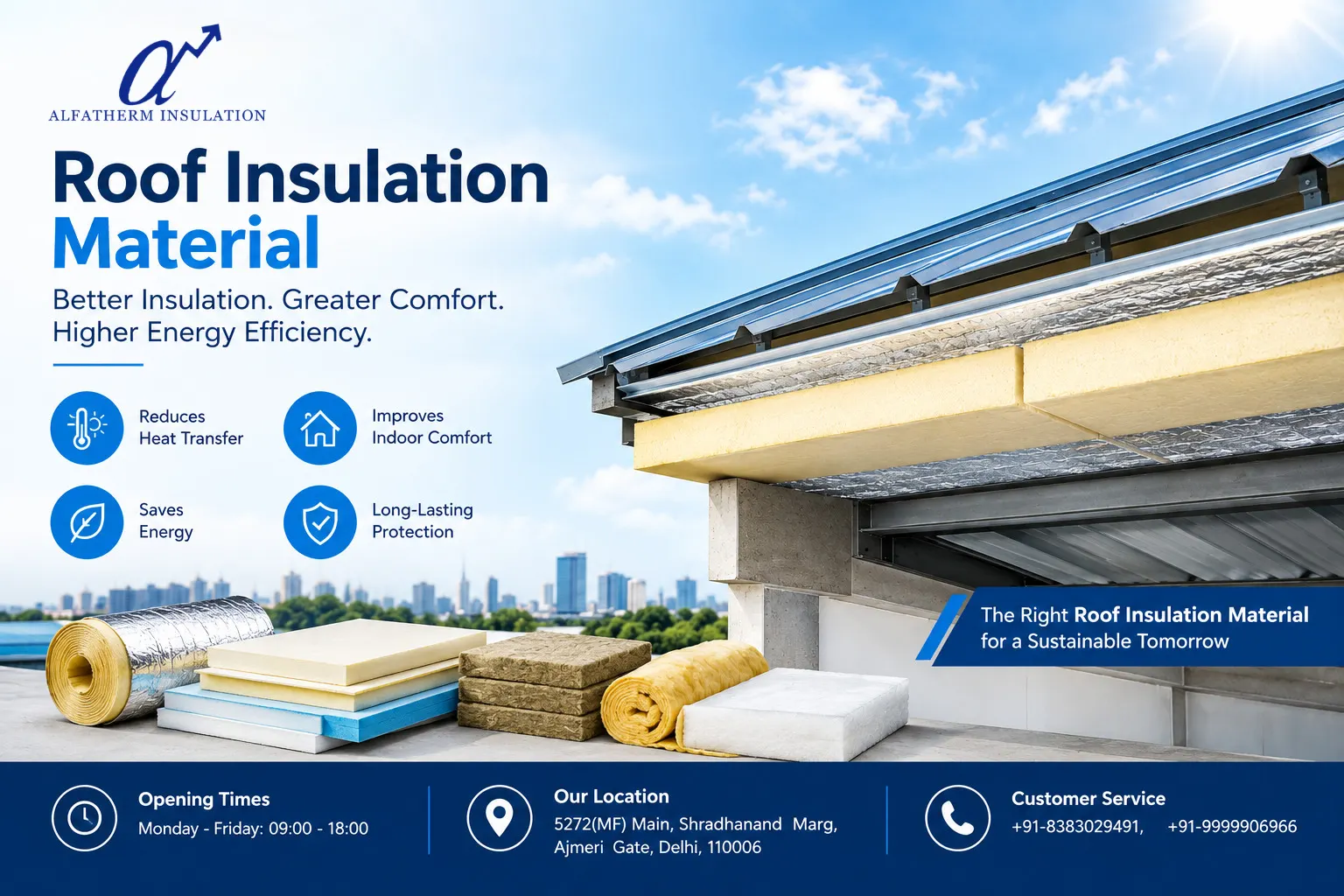
A well-designed roof protects a building from weather while helping maintain indoor comfort. In hot climates, roofs absorb solar heat, increasing indoor temperatures and cooling demand. Choosing the right Roof Insulation Material can reduce unwanted heat transfer. Proper insulation is useful for homes, offices, factories, warehouses, and commercial buildings.
What Is Roof Insulation?
Roof insulation is a layer or system installed within or around a roof assembly to reduce heat transfer between the outside environment and the interior. During summer, insulation can slow the movement of external heat into a building. In colder conditions, it can help reduce the loss of indoor heat.
The performance of a Roof Insulation Material depends on thermal conductivity, thickness, density, moisture resistance, and installation quality.
Why Is Roof Insulation Important?
The roof is directly exposed to sunlight. Concrete and metal roofs can become hotter than indoor spaces. Without insulation, heat can move into occupied areas.
Roof insulation is useful for top-floor rooms, factories, warehouses, and offices.
Types of Roof Insulation Material
Different insulation products have different thermal, moisture, acoustic, strength, and fire characteristics. The choice depends on roof construction, climate, project requirements, and space. The right Roof Insulation Material should match these conditions.
- PUF or Polyurethane Foam
- Polyurethane foam, commonly called PUF, is a high-performance insulation solution. Its closed-cell structure provides strong thermal insulation and useful moisture resistance. PUF can be supplied as panels or applied as foam, depending on the project. It is commonly considered for industrial buildings, warehouses, and cold-storage facilities.
- EPS Insulation
- Expanded polystyrene, or EPS, is a lightweight rigid insulation material. It provides useful thermal insulation while remaining relatively economical. EPS boards can be cut and installed according to roof dimensions. Moisture exposure, fire requirements, protective layers, and product specifications should be considered before installation.
- XPS Insulation
- Extruded polystyrene, or XPS, is another rigid foam insulation option. It generally offers higher strength and lower water absorption than EPS, making it useful where moisture resistance and mechanical durability are important. XPS can be considered for roofs, inverted roofs, floors, and areas where insulation may experience greater loading.
- Mineral Wool and Rock Wool
- Mineral wool and rock wool provide thermal and acoustic benefits and are often selected where fire performance is an important consideration. They are useful in many industrial and commercial applications. Proper moisture protection and installation detailing are important to maintain performance.
- Glass Wool
- Glass wool is a fibrous insulation option used for thermal and acoustic applications. It is available in rolls, blankets, and other forms. It can be useful in metal-roof structures, ceilings, partitions, and industrial buildings. Correct installation is important because gaps, compression, and moisture can affect performance.
- Reflective Insulation
- Reflective insulation uses a reflective surface, such as aluminium foil, to reduce radiant heat transfer. It works best when installed with an appropriate air space. Reflective products can complement bulk insulation and provide an additional approach to managing heat gain in hot climates.
How to Choose the Right Roof Insulation Material
Selection of a Roof Insulation Material should begin with the building’s requirements rather than price alone.
- Consider the Local Climate
- Hot, dry, cool, and humid regions can have different insulation requirements. Climate affects required thermal protection.
- Consider Roof Construction
- An RCC roof may require a different insulation approach from a metal-sheet roof. Over-deck and under-deck systems are also installed differently. The roof structure should be
assessed before selection. - Consider Moisture Exposure
- The Roof Insulation Material should match expected moisture conditions. Waterproofing, drainage, vapour control, and protective layers should be considered together with insulation to support long-term performance.
- Consider Fire Performance
- Fire safety is important when selecting Roof Insulation Material for residential, commercial, and industrial construction. The insulation product, protective layers, roof assembly, and applicable building requirements should be evaluated together.
- Consider Thickness and Installation
- Thermal performance, available space, and project budget should be considered together. Even a high-quality Roof Insulation Material may not deliver its expected performance if it is poorly installed. Gaps, compression, thermal bridges, damaged boards, and poor joints can reduce effectiveness.
Roof Insulation for Homes and Industrial Buildings
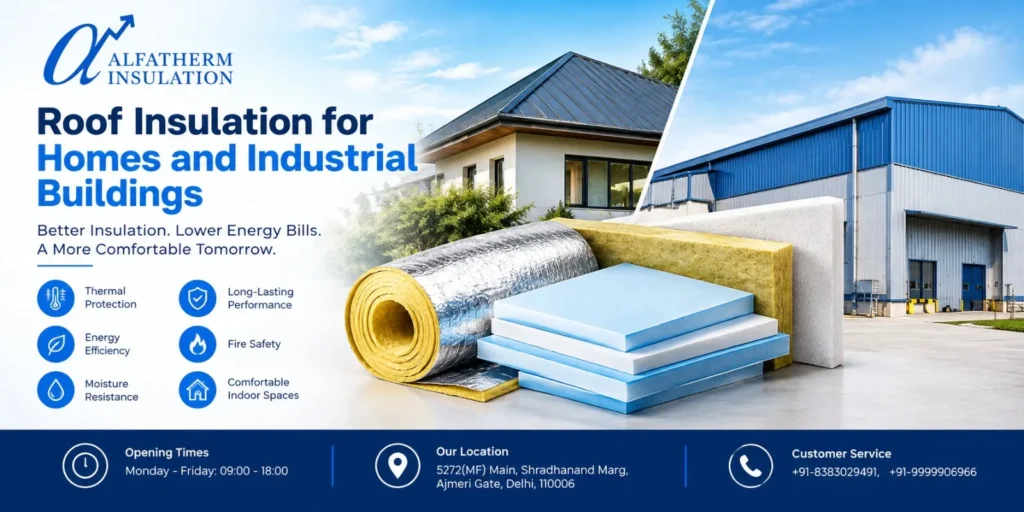
For homes, roof insulation can be valuable in top-floor rooms. Depending on the roof structure, homeowners may consider rigid boards, foam insulation, reflective systems, or mineral wool.
Factories and warehouses often have large roof areas exposed to solar heat. Metal roofing can become especially hot. An appropriate Roof Insulation Material can improve thermal comfort for workers and may help reduce cooling requirements in conditioned areas. Insulated roof panels, PUF systems, mineral wool, and other specialized solutions can be evaluated according to building use.
Roof Insulation and Energy Efficiency
One important purpose of insulation is to reduce unwanted heat transfer. When less heat enters a building, cooling equipment may not need to operate as intensively to maintain desired indoor conditions.
Insulation should therefore be treated as one part of an integrated energy-efficiency strategy. A reflective roof surface can also complement insulation by reducing solar heat absorption.
Why Consider alfatherm insulation?
Choosing a suitable insulation provider is an important part of a roofing project. alfatherm insulation can support customers evaluating insulation solutions for residential, commercial, and industrial applications. Selection should consider thermal performance, durability, moisture conditions, fire requirements, and budget.
A professional insulation provider can assess roof configuration and identify a suitable solution. Property owners should compare technical properties with project conditions.
Common Mistakes to Avoid
Several mistakes can reduce insulation performance. Selecting a product without considering moisture conditions may lead to reduced effectiveness. Ignoring thermal bridges can leave areas where heat continues to transfer rapidly. Fire-safety requirements should not be overlooked.
Insulation alone does not solve every comfort issue. Ventilation, shading, glazing, air leakage, roof reflectivity, and HVAC design also influence building performance. Poor installation can undermine a suitable product.
Conclusion
Choosing the right Roof Insulation Material is an important step toward a more comfortable, energy-efficient, and durable building. PUF, EPS, XPS, mineral wool, glass wool, and reflective insulation each have different characteristics, so the product should be matched with the roof design and project requirements.
A successful insulation system requires more than purchasing a product. Material selection, thickness, waterproofing, fire safety, installation quality, and roof detailing all contribute to final performance. For homeowners, factories, warehouses, offices, and commercial properties, working with an experienced insulation provider can make the selection process easier and more practical. alfatherm insulation can be considered when evaluating insulation solutions for different roofing applications.
0 comments